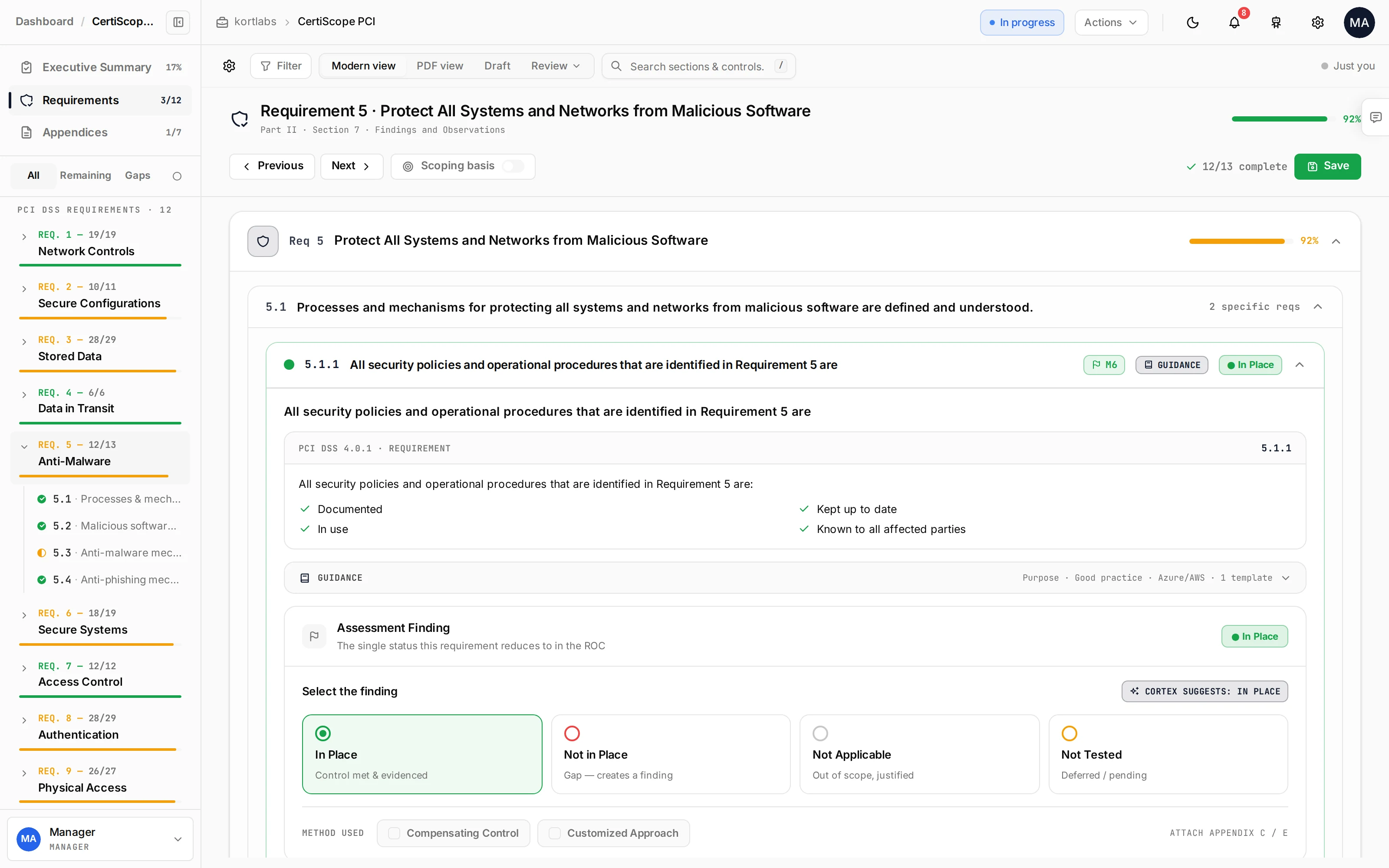
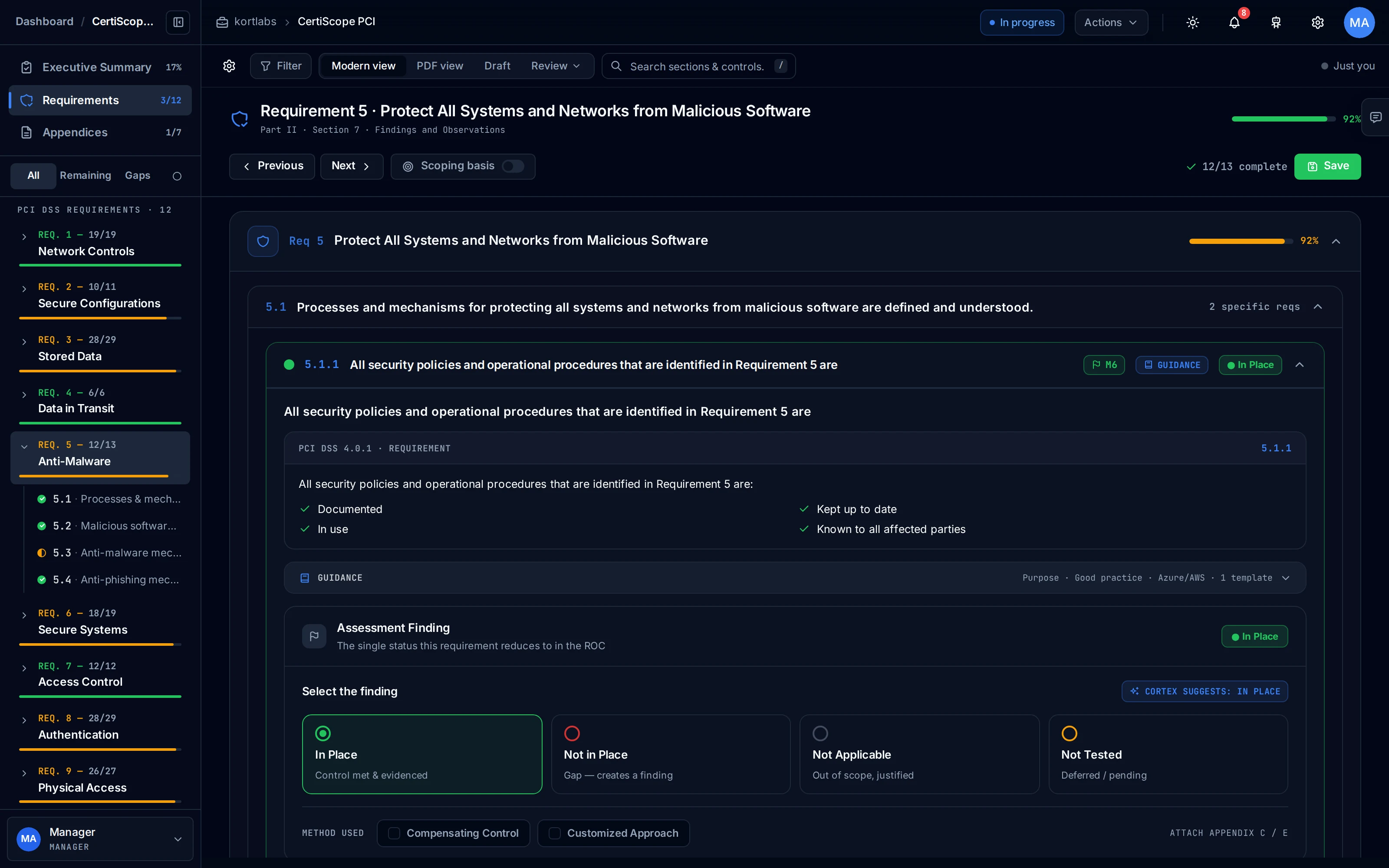
The report is the product. Most tools never touch it.
A Report on Compliance is the assessor’s formal report of a PCI DSS assessment — signed by a QSA, relied on by the client’s acquirer and card brands. Compliance-automation platforms (Vanta, Drata, Secureframe) help the assessed entity collect evidence — none of them produces a ROC. Kliper is the assessor’s tool: template-native, citation-tied, QA-reviewed, exported with its AoC.
The old wayWord · SharePoint · email
ROC in a Word templateversioned by filename — ROC_final_v7.docx
Evidence scattered across foldersSharePoint links and email threads
AoC retyped by handattestation drifts from the report
Cited evidence registryevery response tied to a document or interviewee
AoC from the same dataParts 1–3 auto-filled, no drift
Review queueapprove / send-back with a full audit trail
EVIDENCE & CITATIONS
Every response cites its evidence — including who you interviewed.
Assessor responses reference evidence by tag, and interviewees by their initials from the executive-summary roster. Hover any reference and Kliper shows exactly which document — or which person — it points to.
Tags resolve to real documents in the evidence registry
A · DocumentationIdentify the evidence reference numbers from Section 6 for all documentation examined.
Assessor's responseALLTRADOCAV
B · InterviewsIdentify the evidence reference numbers from Section 6 for all interviews conducted.
Assessor's responseMP
MP · IntervieweeMalcolm Portelli — Chief Information Security Officer
2 of 2 references resolvedResponded
HONEST AI
Cortex drafts the justification. From your citations. Or not at all.
When the responses cite evidence, Cortex drafts the finding justification from those citations — and shows what it saw per reporting instruction. When they don’t, it refuses and lists what’s missing.
Grounded only in resolved citations
No citations, no draft — the gate runs before the model
The assessor examined the anti-malware policy and procedures per DOCAV and verified they cover deployment, scan scheduling, alert handling and periodic review. The assessor interviewed MP, who confirmed the procedures are in use and known to affected parties.
Grounded inDOCAVMP
Accept as justificationDiscard
Cortex draft — not generatedTP 5.1.1
What Cortex sees per instruction
TP 5.1.1 · a · documentationALLTRA cited, no resolved document
TP 5.1.1 · b · interviewscited MP
Missing before a draft can be groundedResolve ALLTRA to a document in the evidence registry, or remove the citation.
Grounded in—
Open evidence registry
“The assessor noted that ALLTRA was listed for documentation coverage, but no resolved ALLTRA document was available for reliance; this justification relies on DOCAV and MP.”
Real Cortex output — declining to lean on a citation it couldn’t resolve
QA TO DELIVERABLES
Nothing ships un-reviewed.
Requirements move through a review queue — drafted, in review, sent back, done — then the ROC exports as print-ready PDF or editable Word, and the AoC is generated from the same data. Incomplete assessments are told exactly what’s missing.
Per-requirement approve / send-back with an audit trail
ROC export on the official template structure
AoC auto-filled, signature blocks left blank
Completeness gate counts unanswered items
Integrity checks flag answers that contradict each other or cite evidence missing from the assessment
Requirement QA1 awaiting review
REQ 1.1.2Network security controls are defined and understood
In review
Send backApprove
REQ 1.2.3Both testing procedures need documented responses
Sent back
REQ 1.1.1Security policies and operational procedures
Done
REQ 1.2.1Configuration standards for network security controls
Drafted
REQ 1.3.1Inbound traffic to the CDE is restricted
Done
Export assessmentNorthwind Trading · PCI ROC
Report on ComplianceAll 12 requirements, appendices, findings and methods
ROC
Attestation of ComplianceParts 1–3 auto-filled, signatures left blank
AoC
Closure planFrom the open gaps, via Cortex
XLSX
PDF · print-readyWord · editable
82% complete · 59 items unanswered
CancelExport
One export — PDF or Word, on the official template
Report on ComplianceROC
All 12 requirements, appendices, findings and methods — print-ready PDF or editable Word, on the official v4.0.1 template.
Attestation of ComplianceAoC
Generated from the same assessment data — Parts 1–3 auto-filled, signature blocks left blank for signing. No retyping, no drift.
Board-level one-pagerPulse
A client-readable posture summary from Kliper Pulse — for the steering meeting, not the auditor.
CORTEX REVIEW
An AI reviewer that tells you how much to trust it.
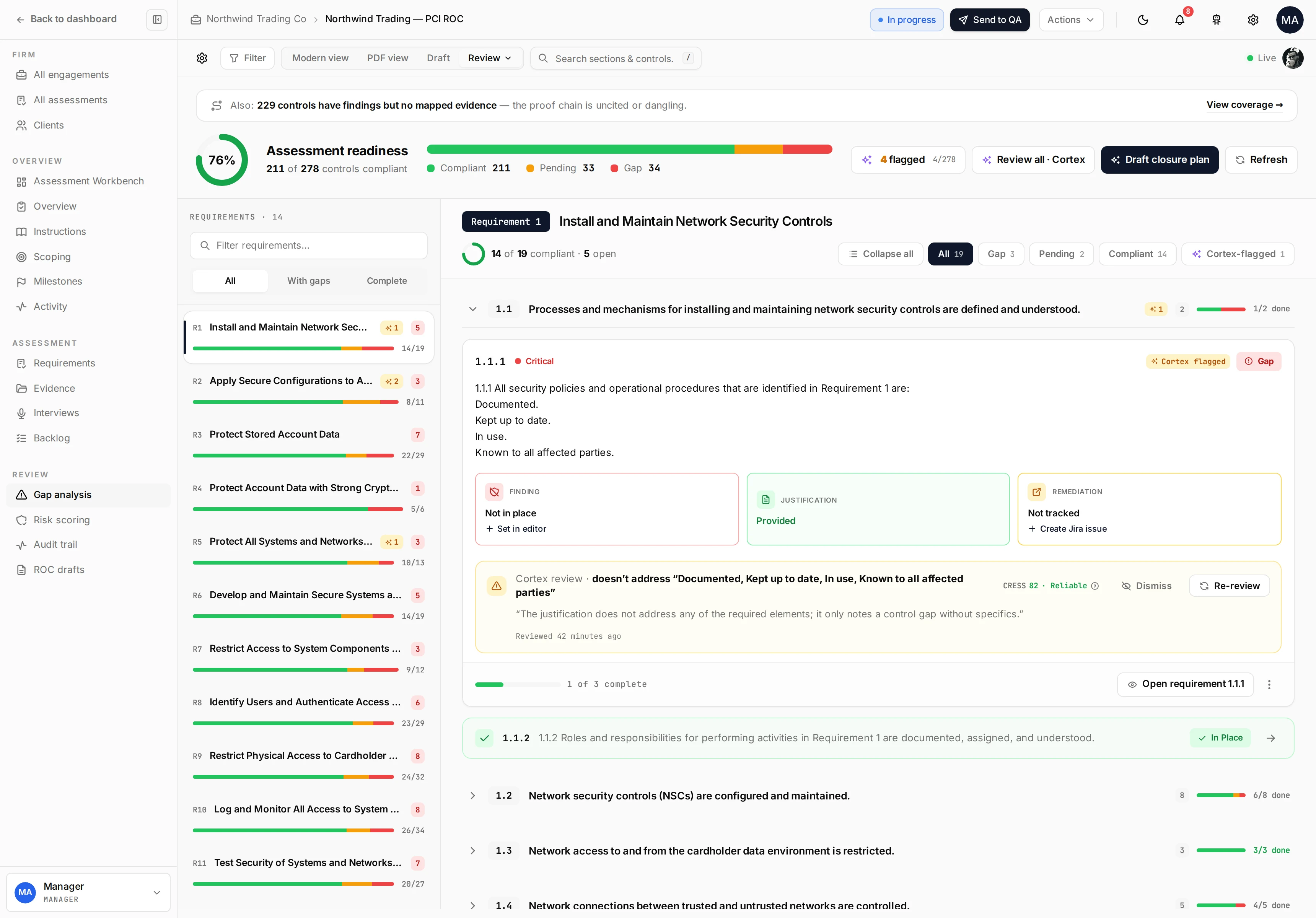
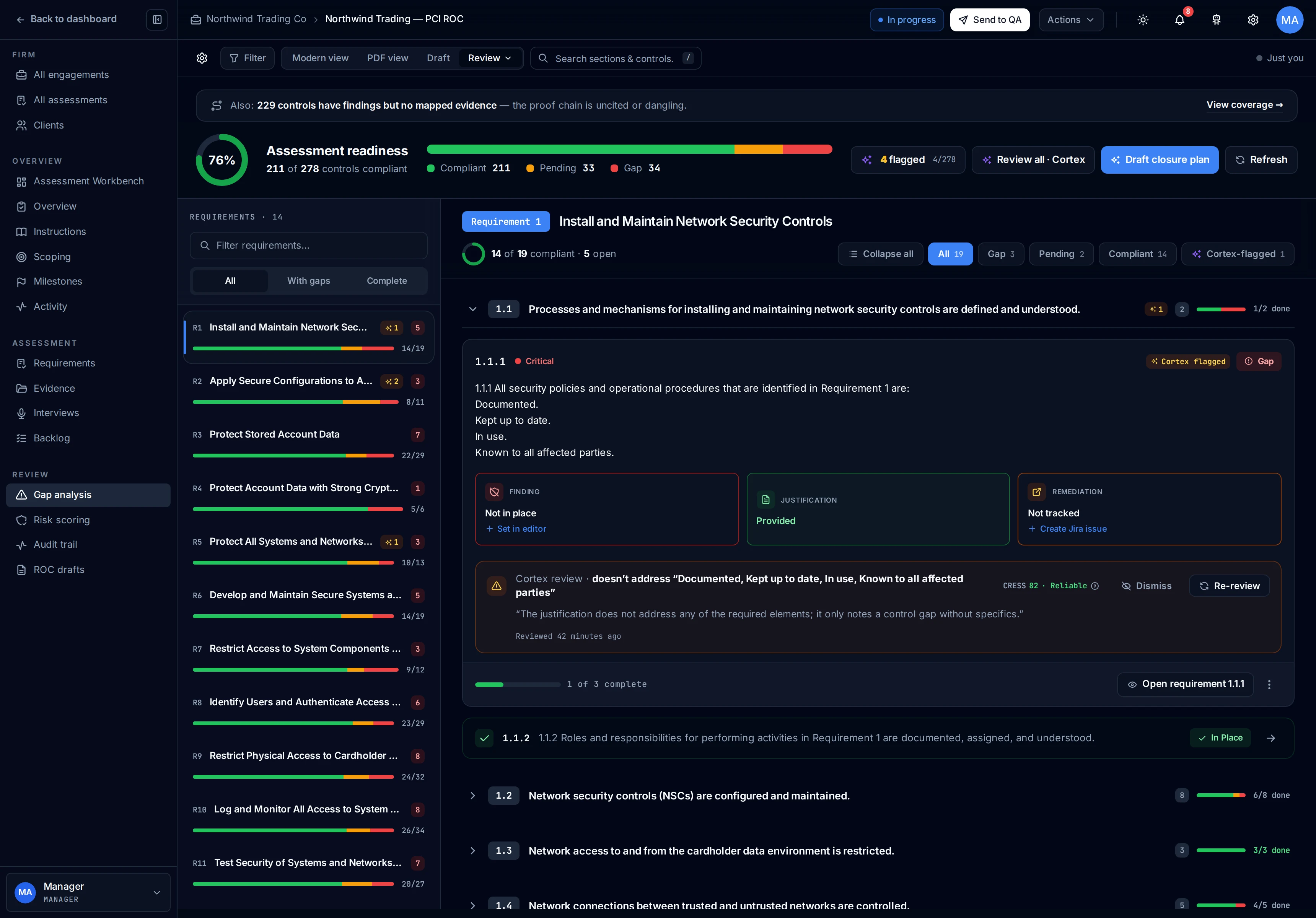
Cortex reviews every requirement’s justification against the official text and flags gaps — “no justification provided”, “doesn’t address all required elements” — with the exact missing element quoted. Every verdict carries a CRESS score (Confidence & Reliability Evaluation Scoring System): how much to trust that verdict, computed from signals that predict correctness — self-consistency, grounding, input sufficiency — not the model grading itself.
Advisory only — a Cortex flag never changes the finding or risk score
Dismiss or re-review per requirement, with an audit trail
Risk scoring per requirement rolls up to an assessment-level view
Cortex review — gaps foundREQ 2.1.1
Flagged“No justification provided.” The response does not address any of the required elements; it only notes a control gap without specifics.
CRESS · reliability of this verdict95/100 · Reliable
Self-consistency30%
Grounding25%
Input sufficiency20%
Requirement difficulty10%
Self-reported confidence15%
Advisory · finding and risk score unchangedDismissRe-review
READINESS & CLOSURE
Know exactly how far from done you are.
Assessment readiness rolls all findings up to one number — compliant / pending / gap per control — with a per-requirement gap browser. Cortex can draft a closure plan from the open gaps, and the coverage check flags findings whose proof chain is uncited or dangling.
“229 controls have findings but no mapped evidence — the proof chain is uncited or dangling.”
Real coverage banner — surfacing findings with no reliance chain
THE ON-RAMP
Scoping that knows why it’s asking.
62 scoping questions auto-populate the assessment sections. Every question carries contextual PCI DSS guidance in the Cortex rail — why it matters, the official references it maps to, and assessor tips. Cortex can propose answers; the assessor confirms.
Answers auto-populate the ROC sections
Per-question PCI DSS references and assessor tips
“Answer with Cortex” proposes, the assessor confirms — answered-by-you vs answered-by-Cortex tracked separately
PCI DSS scoping questions12 of 62 answered
Background · 1 of 3Did we perform any previous PCI work for your company?
YesNoPending · to be confirmed
Background · 2 of 3Are you seeking assistance as a merchant or a service provider?
MerchantService provider · proposed by CortexBoth
Answered by you 9 · by Cortex 3Answer with Cortex
Cortex guidanceQuestion 3 · assessment type
Why it mattersEstablishing the engagement type up front determines the reporting path — ROC or SAQ — and which requirements apply.
PCI DSS referencesPCI DSS v4.0.1 · Assessment ProcessROC Template · Contact Information & Summary of Results
Assessor tipsMerchant vs service provider sets the applicable requirement set and reporting path.Prior scoping work can be reused but must be re-validated for the current assessment period.
“A gap analysis is advisory — it does not produce a formal ROC or AOC.”
Real assessor tip in the Cortex guidance rail
THE LIFECYCLE
One ROC, start to signature.
Six steps, one workspace — from a Word or PDF import to a signed report and its AoC.
01
Import & scope
ROC import from Word or PDF, v4.0 / v4.0.1 auto-detected
02
Evidence & citations
Tags plus interviewee references, resolved server-side
03
Assess with guidance
Per-control purpose, good practice, cloud guidance
04
Draft with Cortex
Citation-gated, human-accepted
05
QA sign-off
Review queue with SLA tracking
06
Deliverables
ROC + AoC + Pulse one-pager
THE LANDSCAPE
Where ROC software sits.
Compliance-automation and generalist audit tools solve adjacent problems — neither produces the assessor's report. Kliper is the only category built to write the ROC itself.
Category
Built for
Produces a ROC?
Compliance automationVanta · Drata · Secureframe
The assessed entity — evidence collection, monitoring, readiness
No
Audit workflow, generalistFieldguide & co.
Audit firms across many frameworks — engagement and request management
Not template-natively
ROC softwareKliper
QSA firms — the PCI DSS assessment itself, template-native
Yes — ROC + AoC
Full breakdown against each platform on the compare page.
Asked before every ROC engagement.
What software do QSAs use to write a PCI DSS Report on Compliance?
Most QSA firms still assemble ROCs in Word templates with evidence scattered across SharePoint and email. Purpose-built ROC software like Kliper replaces that stack: the official template becomes a structured editor, every response cites its evidence, findings roll up automatically, and the finished report exports as PDF or Word.
Does Kliper support PCI DSS v4.0 and v4.0.1?
Yes. A ROC written on either version imports from Word or PDF, and Kliper detects which template it was written on; you assess and export on v4.0.1, the version in force since v4.0 was retired at the end of 2024.
Can Kliper generate the Attestation of Compliance (AoC)?
Yes. The AoC is generated from the same assessment data as the ROC — Parts 1–3 auto-filled, signature blocks left blank for signing. If the assessment isn't complete, the export tells you exactly what's missing instead of shipping a blank.
Does Kliper produce SAQs?
Yes, three: SAQ A, SAQ D for merchants and SAQ D for service providers, each with its AOC, in Word or PDF on the PCI SSC template, answered in the same requirement editor as the ROC. The other SAQs (B, B-IP, C, C-VT, P2PE, SPoC) are not built.
Does Kliper cover Appendix A3 for designated entities?
Yes. Answer Designated Entity in scoping and Appendix A3 opens in the requirement editor with its 20 requirements; the DESV Supplemental ROC and its AOC export as Word or PDF beside the ROC and AoC.
Can next year’s ROC start from this one?
Yes. A new assessment for the same client can carry the answers forward from a previous assessment of the same framework, for the assessor to re-validate.
Which languages does Kliper speak?
The app is in English, French, Spanish and German. The ROC, AoC and SAQs export in English, on the PCI SSC templates.
Does Kliper work on a phone?
Yes. The assessment pages, the ROC editor, the evidence table and the client portal work at phone width, for reviews and quick answers away from a desk.
How does Cortex avoid inventing assessment content?
Drafting is citation-gated. Cortex only drafts a justification from evidence the assessor has already cited — documents and interviewees resolved server-side. No citations, no draft: it tells you what's missing instead. Nothing is ever auto-applied; every draft is reviewed and accepted by the assessor, and accepted text is marked with its AI provenance.
Can clients upload evidence without a Kliper account?
Yes. The client portal lets your client's contacts respond to requests and upload evidence against specific requirements — no seat required. Firms on SharePoint can also connect a document library and pull evidence straight from it.
Is Kliper built for QSA firms running many clients?
Yes — it's multi-tenant by design. Each firm runs in an isolated tenant with role-based access, a review workflow for QA sign-off, and enterprise SSO. Engagements, assessments and evidence are scoped per client.
Bring a real ROC. Leave with it modelled.
A 25-minute walkthrough with one of our engineers, on your own engagement — not a canned demo.